Never since the end of World War II have we have witnessed events on the international scene unfurling at such a pace and with such inconsistency that they verge on incomprehensibility. While there is no dearth of pundits ready to expound on how they see the world at any given time, no soothsayer has yet emerged to predict, with conviction and empirical evidence, the future in the short, medium and long terms.
The unpredictable events that unravel daily on the world scene can easily put paid to any forecast, however learned its source. We are living through a shifting sands period. This situation has brought many a country to redraw the fundamentals and parameters of its domestic and foreign policies.
Any lingering doubts that the old order has been shredded were dispelled when the Trump administration mounted its first direct military attack on Venezuela and exfiltrated Nicholas Maduro and his spouse in January.
Writing in the UK Guardian, columnist Nesrine Malick said that this time, there was not even a pretense of trying to justify the action in terms of global security as it had happened in the past.
“Maduro ‘effed around and found out’, said the US defence secretary, Pete Hegseth. ‘America can project our will anywhere, any time.’
The US will now ‘run Venezuela’ said the president, Donald Trump. ‘We are going to have a presence in Venezuela as it pertains to oil.’ There is little to no effort to make reasonings for the takeover cohere,” she writes.
Will 2025 be recorded as the year in which the international order that has hitherto informed the behaviour of the world collapsed? The picture that is emerging is clear: the order that has served the international community in good stead and acted as a leash to restrain it from going astray is today being battered by near-hegemonic behaviour of the mighty.
Founding moment
On 26 June 1945, in the wake of two devastating world wars, 50 states signed the United Nations Charter. It was time for a solidly anchored rules-based world. The lofty objective was to maintain international peace and security while achieving cooperation among nations on economic, social and humanitarian matters.
Eighty years later, one would have thought that an organisation of that stature, now boasting 193 member states, would be firmly anchored and consolidated. The reality is that our world is under assault: the old adage “might is right” is fast becoming the new norm.
The end of the Cold War ushered in a new environment; but it turned out to be ephemeral. Certain events that developed in the years that followed that milestone in our contemporary history soon displayed visible cracks in the multilateral system.
The 11 September 2001 terror attacks on US soil were conveniently used to justify the March 2003 invasion of Iraq – for which the US failed to obtain a mandate at the UN. Despite the dramatic performance of then US Secretary of State Colin Powell at the Security Council, no weapons of mass destruction were ever found in Iraq.
Add to these events in Ukraine, Gaza and Sudan, to name but some, and the picture that emerges is one of UN helplessness.
The UN’s modus operandi no longer serves its objective. The biggest stumbling block is that five permanent members hold veto power in the UN Security Council. The veto is often used to torpedo well-reasoned attempts at solving a crisis peacefully – the bedrock of the UN’s existence – depending on what the permanent members perceive as their national interest or that of their allies, as when the US has vetoed resolutions critical of Israel.
Veto power does not reflect current reality
Between 1945 and 1964 these five countries successfully carried out nuclear weapons tests. Since then, four more countries are known or suspected to have joined the nuclear arms club. Economic power has shifted; China and India have moved up the ladder. Yesterday’s alliances are in question.
As an example, the thawing of relations between China and India will bring a new perspective to the world scene. Russia will be in that camp and will encourage a rapprochement to counter the perceived aggressive, if not coercive, posturing of the US.
US President Donald Trump’s tariffs are shackling everyone. In effect, West Europe is treading with unsure feet, with a total absence of cohesion on foreign policy. The insistence of the US that the European members of the NATO should spend 5% of their GDP on defence isn’t popular with their public opinion.
An alternative to might is right
The cohesive and consensual dynamics of interactions at the level of the United Nations that have informed it and stood it in good stead thus far are fading. Other international, regional and sub-regional bodies are losing their lustre and raison d’être. The Non-Aligned Movement, which was a force to reckon with during the Cold War, has practically slid into oblivion.
Has multilateralism reached its expiry date? The more cynical could conclude so, especially in the global South. The US has withdrawn of the from some organisations. Aid funds are drying up. Essential programmes are being curtailed or abandoned.
The atrocities unleashed in the Gaza Strip, where the weaponisation of hunger and famine are causing as many casualties as actual bombs, are a clear demonstration of the failure and helplessness of the United Nations at the political level. The world is losing its bearings. So, is the new norm: each one for themself?
No country can go it alone, even if, temporarily, it may appear advantageous to do so for some. One simply cannot live within a fortress. In today’s world, if countries want to live in peace and harmony, lift up their societies, they need each other, more than ever.
The present form of multilateralism, if allowed to slide further, is probably breathing its last. But can we afford to let it succumb, or is it time for us to set the wheels in motion to revive it, but in a new format that satisfies universal aspirations, in which no one is left behind, where each voice counts, where, in moments of need, we can truly count on each other?
The UN has to be restored to its prime position and not continue to be merely a forum for debate and resolutions.
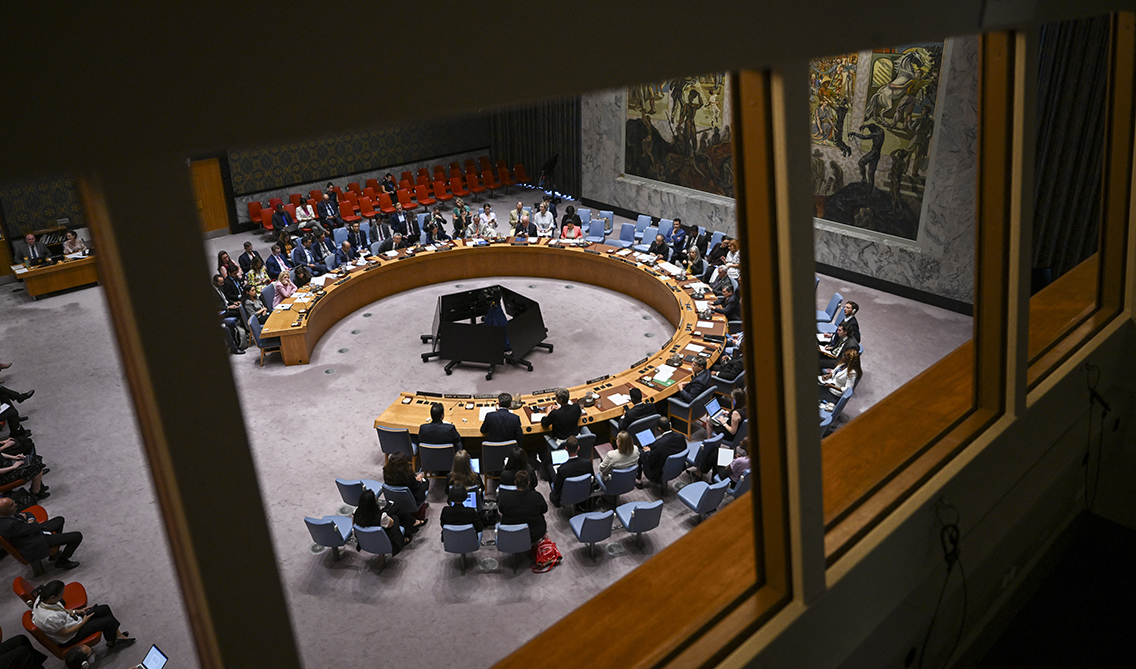
The Security Council is nearly obsolescent. Its membership is too constrictive and not representative at all of the international community as it stands today. Entire regions are either not on board or have representatives who can play but a perfunctory role.
The membership of the Security Council needs to be expanded so that all geographical regions of the world, including small island developing states, are adequately represented. The veto power retained by the five countries has been used more often than not to stymie resolutions of conflicts and attempts to exercise the rule of international law.
If it is difficult and perhaps inconceivable for those who hold such power to give it up, then consideration should be given to widen the field to other countries and regions and extend to them permanent membership with veto power. Countries such as India, Japan, Brazil, South Africa and Egypt should be considered. In the case of the African membership, a system of rotation could be envisaged.
To obviate blockage at the Security Council, we could resolve that no single veto can stop a resolution unless two other veto-holding countries are in support. Consider a counter-veto system, in which all other veto-holding member states in an expanded Security Council can vote down a vetoing country.
The uncertain future of multilateralism is agonising. What will this chaotic paradigm lead to? Will it last? Unravelling the spaghetti bowl that seems to depict the current state of affairs on the international scene is a mammoth undertaking.
The opinions expressed in this article are the author’s personal views.