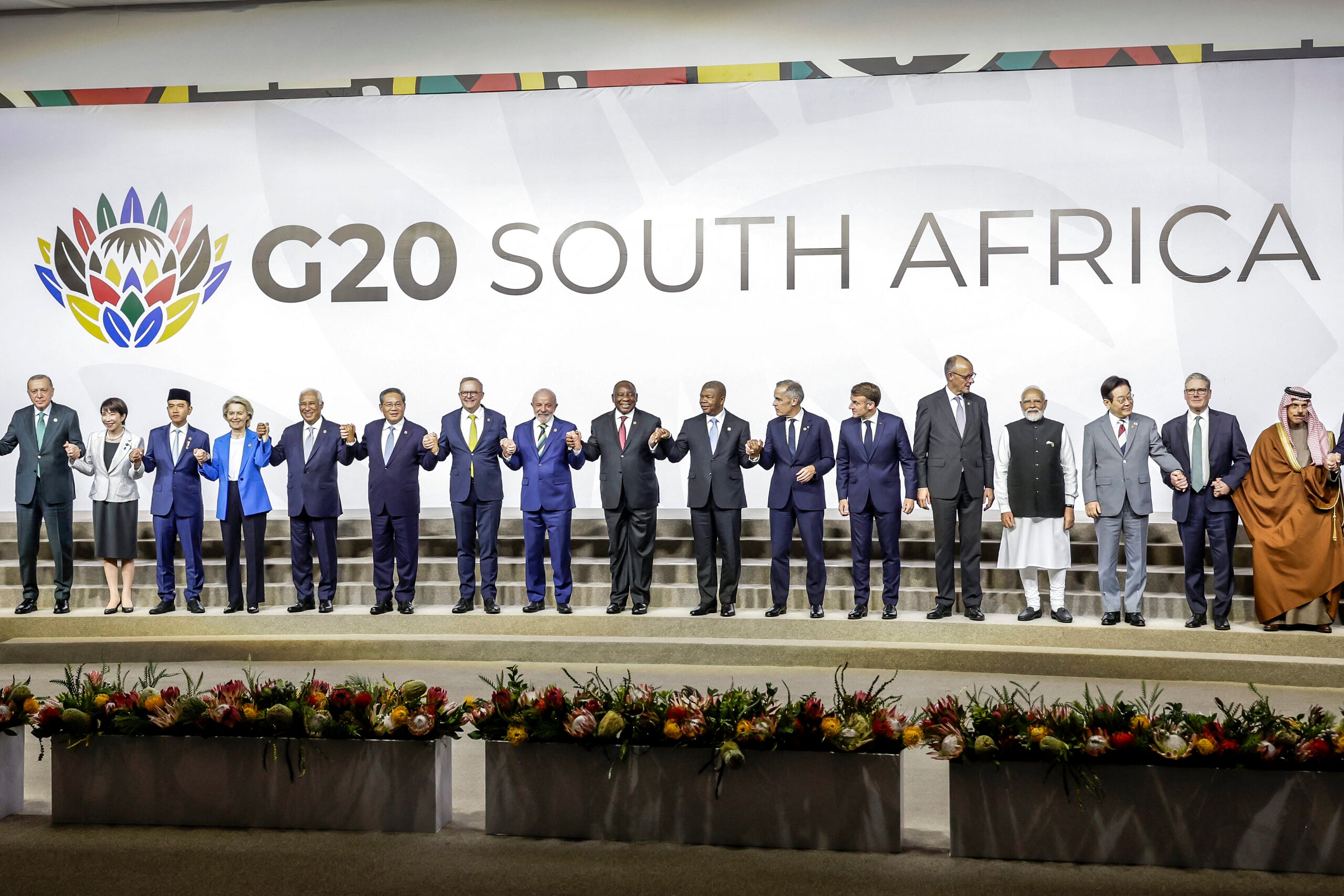
World leaders have agreed to a joint declaration at the G20 Summit in Johannesburg despite US President Donald Trump’s boycott of the event.
The declaration, which host President Cyril Ramaphosa is likely to see as a vindication of South Africa’s agenda for the G20 in the face of concerted US pressure, leads with a call for more support for poorer countries in facing climate change and other disasters.
“We highlight the need to pay special attention to those already disproportionately impacted by disasters and that cannot afford the costs of adaptation, disaster mitigation, preparedness and recovery in particular, Small Island Developing States (SIDS) and Least Developed Countries (LDCs),” the declaration reads.
The declaration calls for the greater use of “affordable, inclusive and accessible pre-arranged financing mechanisms” to strengthen disaster risk reduction and preparedness.
The 30-page document goes on to reflect other pressing concerns of less economically developed countries that South Africa had prioritised in its agenda, including taking action to ensure debt sustainability for low-income countries; mobilising finance for just energy transitions; and harnessing critical minerals for inclusive growth and sustainable development.
On debt, the summit reaffirmed “our commitment to support efforts by low- and middle-income countries to address debt vulnerabilities in an effective, comprehensive and systematic manner.”
On critical minerals, the declaration pledged to support increased exploration, “particularly in developing countries” and called for “promoting diversification of mineral sources, routes, markets, processing locations, and value chains; enhanced value retention and beneficiation in mineral endowed developing countries” and the implementation of environmental, social and governance standards.
Christopher Vandome, senior research fellow with Chatham House’s Africa and global economy and finance programmes, said that the Summit reflected South Africa’s wish to put African issues on the global agenda, even as other geopolitical crises attract more international attention.
“I think it’s shown that South Africa is one of the most capable among the African nations of articulating African issues on a global stage. It’s shown that South Africa is committed to the Africa agenda.”
Ramaphosa hails declaration
While little that is covered in the document is dramatically new – calls for disaster response and climate adaptation echoed well-worn discussions at the just-concluded COP30 in Belém in Brazil – the fact that a leaders’ declaration has been achieved despite the absence of US President Donald Trump and his senior team will be viewed as a significant victory for the hosts.
In his opening address at the Summit on Saturday, Ramaphosa hailed the declaration.
“The adoption of the declaration from the summit sends an important signal to the world that multilateralism can and does deliver. It sends a message of hope and solidarity. It tells the world that as the leaders of the G20, we will keep fast to our solemn pledge to leave no person, no community and no country behind.”
Ramaphosa had put global inequality and the concerns of Africa at the centre of the country’s year-long presidency of the G20, an approach that drew the ire of the United States. Months before the summit, US secretary of state Marco Rubio accused South Africa of peddling a G20 agenda defined by “DEI [diversity, equity and inclusion] and climate change”.
Trump left on sidelines
Weeks before the summit, Trump confirmed that none of his cabinet members would attend, again citing his discredited theories around the mass killing of Afrikaners. Vice-president JD Vance had for some months been expected to attend.
Argentina, led by Trump ally Javier Milei, who also did not attend the Summit, did not endorse the declaration.
“Argentina, although it cannot endorse the declaration… remains fully committed to the spirit of cooperation that has defined the G20 since its conception,” its foreign minister Pablo Quirno said at the summit.
Vandome said that this statement represented a significant achievement for the hosts.
“The US absence actually made it potentially more likely to get a declaration. South African was worried that the Argentinians would try and block things, but in fact they managed to get a declaration out with a lot of what Ramaphosa wanted to say, which is brilliant. That’s as much as they could have hoped for really. And it shows there is a broad commitment to multilateralism. People were there for genuine serious dialogue on genuine serious issues.”
After months of attempting to soothe relations with the US following a disastrous Oval Office meeting between Ramaphosa and Trump in May, the US boycott of the event appears to have pushed South Africa into a much more assertive position, both in pushing its agenda for the Summit and in insisting that the US respects diplomatic protocol.
Vandome says that South Africa felt more emboldened to stand up for itself during the Summit.”As you get towards the end you think ‘we’ve tried softly softly and now let’s just go for it’. And the closer you get to the Summit, the more the rest of the world is watching. You can feel a little more emboldened, especially during the Summit when everyone is there. Everyone’s dealing with a Trumpian world. There will have been a lot of messages of sympathy [for South Africa].”